
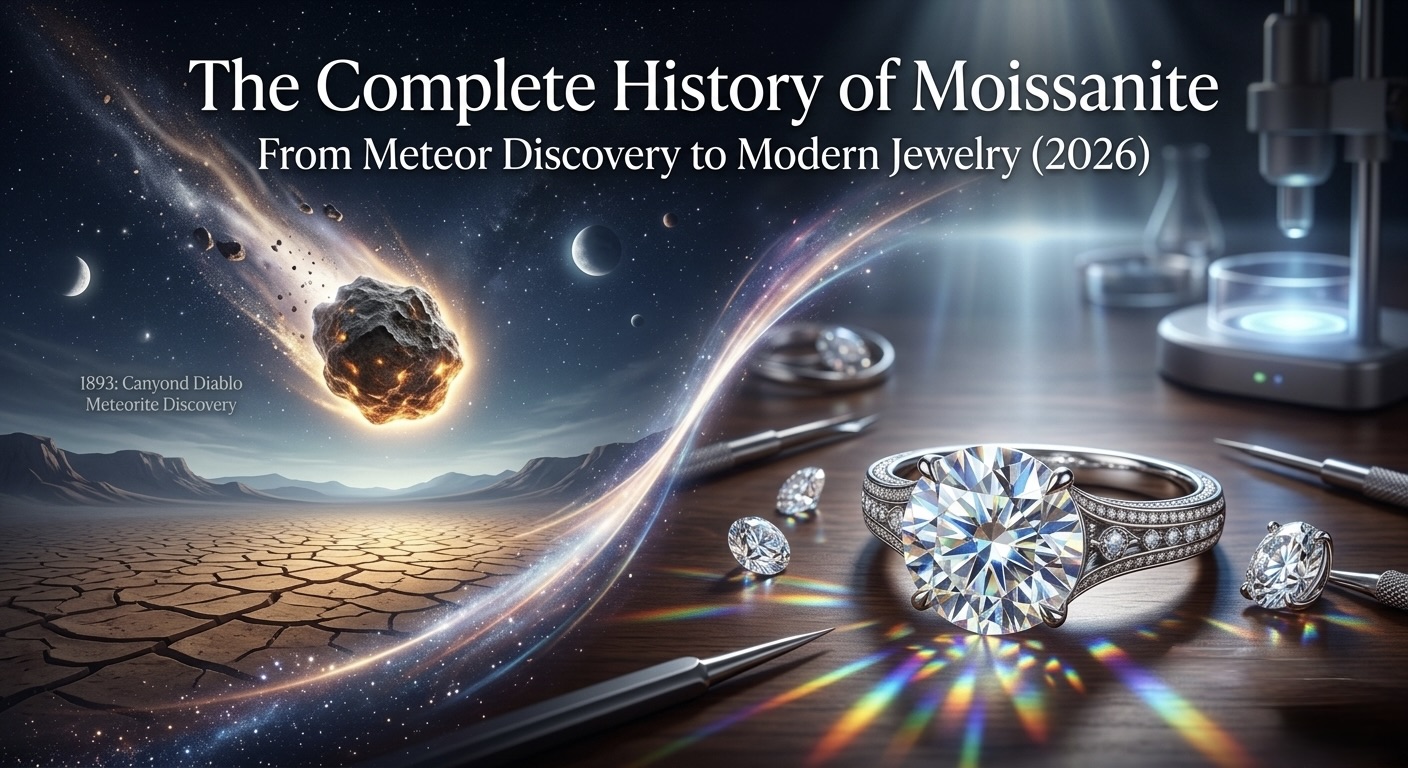
Moissanite was discovered in 1893 in a meteor crater region in Arizona and is now lab-created for modern jewelry.
What Is the History of Moissanite?
The history of moissanite gemstone begins with a rare natural discovery and continues into modern lab-created jewelry. It is made from silicon carbide and is known for its strong sparkle and durability.
This guide explains the complete history of moissanite gemstone, including its discovery, origin, and evolution into modern jewelry.
Many people search for “who discovered moissanite” and “is moissanite natural or lab-made”—this guide answers everything in simple terms.
The moissanite origin story and key moissanite discovery facts make it one of the most unique gemstones available today.
Today, moissanite is considered one of the most important modern gemstone innovations in the jewelry industry.
Explore modern jewelry styles like our Moissanite Chain collection designed for everyday luxury and bold shine.
Moissanite Origin Story (1893 Discovery)

If you’re wondering who discovered moissanite, it was Henri Moissan in 1893.
He found tiny crystals while studying meteorite fragments from Arizona.
At first, he thought they were diamonds. Later, scientific analysis confirmed they were silicon carbide (SiC), a completely different mineral.
👉 Geological studies confirm that moissanite forms under extreme pressure conditions, such as meteor impacts.
Why Natural Moissanite is So Rare
Many people ask, where does moissanite come from?
Natural moissanite is extremely rare because:
- It forms under extreme conditions like meteor impacts
- It exists only in very small quantities
- It is not found in large mines like diamonds
👉 Scientific research shows that natural moissanite is too rare for commercial jewelry use.
Lab-Grown Evolution (1990s Breakthrough)
Although discovered in 1893, moissanite was not used in jewelry until much later.
In the late 1990s, companies like Charles & Colvard developed methods to create gem-quality moissanite in laboratories.
This allowed:
- Better clarity and consistency
- Controlled production
- Affordable pricing
Today, lab-grown moissanite is widely used in modern pieces like Moissanite Pendants for everyday luxury styling.
Scientific Strength of Moissanite (Silicon Carbide)
Moissanite is not just about looks—it’s also technically strong.
- Hardness: 9.25 on Mohs scale
- Highly scratch-resistant
- Stable under heat and pressure
This durability makes moissanite ideal for long-lasting pieces like Moissanite Watches and everyday jewelry.
Moissanite in Jewelry Today (2026)

In 2026, moissanite is widely used in modern jewelry because it offers a luxury look at a better price.
It is commonly seen in:
- Cuban link chains
- Tennis chains
- Bracekets
- Pendants
👉 Many buyers today prefer moissanite Cuban link chains and moissanite tennis chains for better value and long-lasting shine.
Related Jewelry
- Moissanite Cuban Link Chains
- Moissanite Tennis Bracelet
- Moissanite Pendants
👉 These styles are popular for modern luxury and everyday wear.
Moissanite vs Diamond (Historical Perspective)

From a historical point of view:
- Diamonds → mined and used for thousands of years
- Moissanite → discovered in 1893 and developed through modern science
👉 Diamonds represent tradition, while moissanite represents innovation.
Why Moissanite History Matters
Understanding the origin of moissanite helps buyers trust the product:
- It is not a fake diamond
- It has a real scientific background
- It comes from a rare natural discovery
- It is engineered for better performance today
👉 This makes moissanite a modern, science-backed gemstone.
For personalized designs, explore our Custom Moissanite jewelry and Custom Moissanite Pendant service to create a unique identity piece.
Key Facts About Moissanite
- Discovered: 1893
- Discoverer: Henri Moissan
- Origin: Canyon Diablo meteorite site (Arizona, USA)
- Composition: Silicon carbide (SiC)
- Natural form: Extremely rare
- Commercial use: Developed in the 1990s
- Today: Lab-grown gemstone
FAQs – Moissanite History
Who discovered moissanite?
Moissanite was discovered in 1893 by French scientist Henri Moissan.
Where does moissanite come from?
Moissanite was first found in meteorite fragments in Arizona, USA, and is now primarily lab-created for jewelry use.
Is moissanite natural or lab-made?
Natural moissanite exists but is extremely rare. Most jewelry-grade moissanite is lab-grown for consistency and clarity.
Why is moissanite rare?
Moissanite naturally forms only under extreme pressure and temperature conditions, making it extremely rare in nature.
Is moissanite from space?
Yes, moissanite was first discovered in meteorite material, which is why it is often associated with a space origin.
Summary
Moissanite has evolved from a rare mineral found in meteorite material into a widely used gemstone in modern jewelry.
It offers durability, brilliance, and better value, making it a smart alternative to diamonds.
In 2026, moissanite is not just an alternative—it’s a practical and modern choice for buyers who want both style and value.